
Pupae
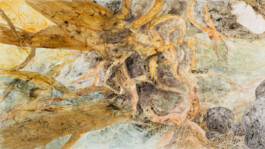
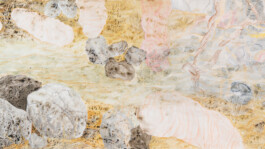
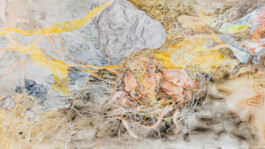
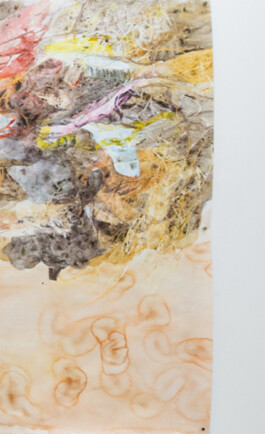
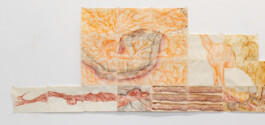
Pupae presents a series of large-scale works on paper in wide format—‘scrolls’—alongside smaller drawings that accompany the work process. The series was created with landscape and vegetation images in mind, focusing on the seam between the human environment and nature. It continues Itzhaky's interest in fallow fields and desolate areas as the "degree zero" of the landscape, a landscape which has no prominent or unique features but is all "dead space," an intermediate zone dotted with minor events.
The works are created on the floor, kneeling on all fours and crawling across the paper, so the complete image is only revealed in hindsight. The large scale and changing directionality - up and down, vertical and horizontal, near and far - creates an image that must be taken in strides or read like a text, in connection to the Chinese and Japanese tradition of scroll paintings. The world created in the scrolls similarly evokes a sense of a changing scale, of movement from the micro to the macro, from the inside of the body to the outside, from soaring to diving. The paintings are based on the metaphor of metabolism: materials changing state in the exchange between the body and its surroundings, between one body and another, between living and dead matter.
The landscape and the body mix into a series of textures - dirt, skin, weeds, hair, scars, mud, and fluids - created by the repulsion between the oily pastel and liquid watercolors. From these textures, images emerge: animals feeding on a corpse, boars rummaging through trash, a woman urinating in a stream, pupae resting in the mud, and more. These images call to mind dissolving, fluid bodies, assimilating into a world where everything is alive and therefore everything also dies, decays, and rots.

Pupae, 2024, exhibition view, Dvir Gallery, Tel Aviv. Photo credit: Daniel Hanoch

Pupae, 2024, exhibition view, Dvir Gallery, Tel Aviv. Photo credit: Daniel Hanoch
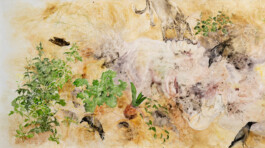
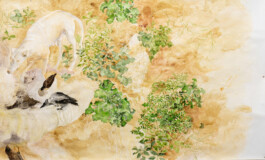

Pupae, 2024, exhibition view, Dvir Gallery, Tel Aviv. Photo credit: Daniel Hanoch

Pupae, 2024, exhibition view, Dvir Gallery, Tel Aviv. Photo credit: Daniel Hanoch
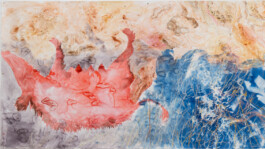
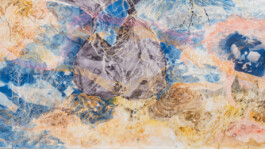
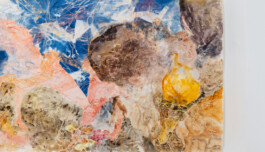

Alma Itzhaky, Pupae, 2024, exhibition view, Dvir Gallery, Tel Aviv. Photo credit: Daniel Hanoch
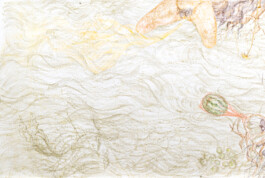
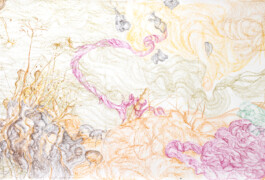
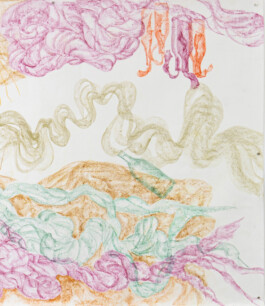

Pupae, 2024, exhibition view, Dvir Gallery Tel Aviv , photo credit: Daniel Hanoch

Milk and Blood, 2025, oil pastel and watercolor on paper, 150×320. Photo Credit: Daniel Hanoch
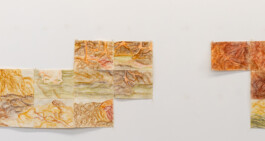
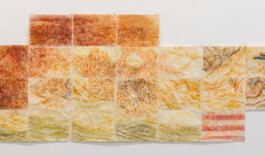
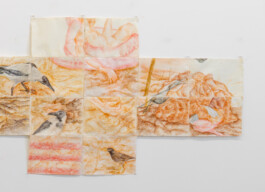

Maps of Withdrawal is an ongoing series that employs drawing as a means of spatial reflection, using the act of mark-making on paper as an attempt to orient oneself and to document spatial memories.
It comprises a series of works on paper conceived as mental or allegorical maps of biographically significant places, reflecting experiences of attachment and loss. They were created as a personal and artistic response to the state of catastrophe, political deadlock, and moral collapse in Israel/Palestine, the artist’s country of origin. This exploration confronts a cruel reality in which geography becomes destiny, asking what it means to have a place to live, and conversely, what it means to destroy such a place.

Please Open Your Eyes, 2025, exhibition view, Dvir Gallery Tel Aviv, photo credit: Daniel Hanoch

Map no. 3: Self-Portrait with a spider, moths, stones, and the Jordan River. Oil pastel, inkjet print, and collage on paper, variable dimensions. Photo: Eric Tschernow

Map no. 4: Stones in the stomach (where I used to live), oil pastel on paper, variable dimensions. Dvir Gallery, Tel Aviv. Photo: Elad Sarig

Map no. 5: Abu Kabir, oil pastel on paper, variable dimensions. Photo: Eric Tschernow
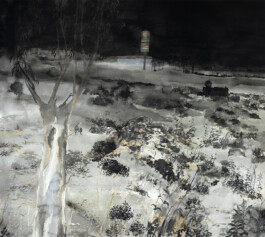
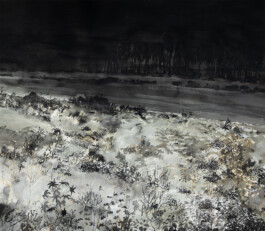

Ruderal Communities is a series of ink drawings depicting the landscapes around the Abu Kabir neighborhood in Jaffa, which was built on the land of destroyed Palestinian neighborhoods and orange orchards. The drawings show the area’s typical patchwork of vacant lots, ruins, and rampant urban development. “Ruderal communities” is a botanical term referring to plant species that colonize disturbed areas. It literally means “rubble communities.” It applies here both in the proper botanical sense and metaphorically to designate commonality in precarious and impoverished environments. The series was developed as part of a research group on Abu Kabir and exhibited at the Center for Digital Art in Holon, and was included in a special online issue of Ma’arav Magazine.
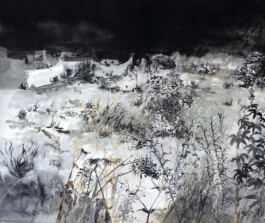
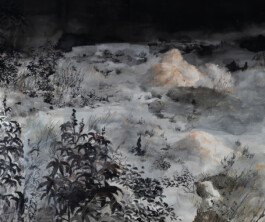
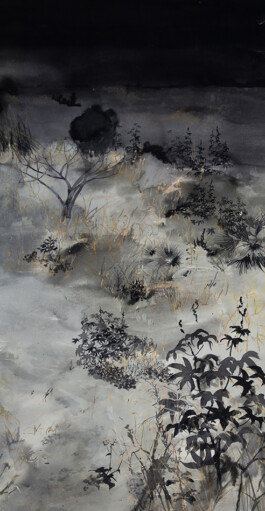

Ruderal Communities
2021-2022
Ink and crayons on paper
70×50 cm each


Pupae, 2024, exhibition view, Dvir Gallery, Tel Aviv. Photo credit: Daniel Hanoch
Pupae, 2024, exhibition view, Dvir Gallery, Tel Aviv. Photo credit: Daniel Hanoch
Pupae, 2024, exhibition view, Dvir Gallery, Tel Aviv. Photo credit: Daniel Hanoch
Pupae, 2024, exhibition view, Dvir Gallery, Tel Aviv. Photo credit: Daniel Hanoch
Alma Itzhaky, Pupae, 2024, exhibition view, Dvir Gallery, Tel Aviv. Photo credit: Daniel Hanoch
Pupae, 2024, exhibition view, Dvir Gallery Tel Aviv , photo credit: Daniel Hanoch
Milk and Blood, 2025, oil pastel and watercolor on paper, 150×320. Photo Credit: Daniel Hanoch
Please Open Your Eyes, 2025, exhibition view, Dvir Gallery Tel Aviv, photo credit: Daniel Hanoch
Map no. 3: Self-Portrait with a spider, moths, stones, and the Jordan River. Oil pastel, inkjet print, and collage on paper, variable dimensions. Photo: Eric Tschernow
Map no. 4: Stones in the stomach (where I used to live), oil pastel on paper, variable dimensions. Dvir Gallery, Tel Aviv. Photo: Elad Sarig